
Luxury carmakers are shifting into high gear with a mix of product launches, personalised experiences and lifestyle-led engagement.

'Even if tariffs are reduced, non-tariff may still remain a challenge.'

'A deal will only be possible if India stops buying Russian oil -- but even then, New Delhi must not compromise its core red lines.'

'Our endeavour will be that we identify these products, put them in the public domain so that the manufacturers can look at them and give a boost to Make in India.'
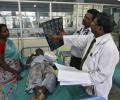
The rationalisation of goods and services tax (GST), announced on Wednesday, directly lowers the cost of everyday medical consumables, and also high-end therapies in oncology and rare diseases, helping reduce out-of-pocket patient expenditure and better adherence to medication.

The country's largest carmaker Maruti Suzuki India expects auto sales to bounce back to the glory days of 7 per cent growth by FY 27, helped by the proposed GST rate cut which is expected to bring down car prices by 3.5 to 8.5 per cent.

'Despite assurance from China, none of the companies have received supplies from Chinese sellers.'

As the potential threat of a steep 200 per cent tariff on pharmaceutical imports hangs in the air, analysts and industry insiders feel that focus on exports to non-US regions as well as domestic market will increase as a long-term trend. US President Donald Trump told CNBC's Squawk Box in the first week of August that planned tariffs on import of pharmaceutical products to the US could eventually reach up to 250 per cent.
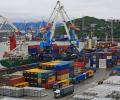
'There is definitely tepid demand because of the (reciprocal tariff) uncertainty.'
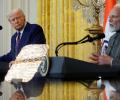
The deal fell through over unresolved disagreements over contentious issues, mainly on agriculture and automotive sector tariffs.

India's goods exports rebounded in July after two months of contraction, with outbound shipments rising 7.3 per cent to $37.24 billion, led by a surge in exports to the United States before the country's reciprocal tariff kicked in and bolstered by a recovery in exports to other key markets.
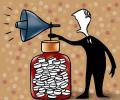
If pharmaceutical exports from India to the US come under a 25 per cent tariff bracket, the impact on earnings before interest, tax, depreciation and amortisation (Ebitda) could be around 5 per cent, felt analysts. This is after assuming that about 75 per cent of the tariff would be passed on.
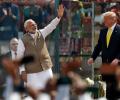
'It's important for India to think about areas where it wants the US to move.' 'We can be far more innovative in what we ask the US.' 'Given that there's a package deal, why not do it?'
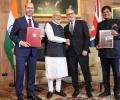
'That way you're not hostage just to US sort of exports to India.'
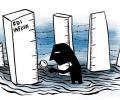
The government has identified critical sectors, including electronics, chemicals, leather and footwear, and toys, where value chains can be strengthened to facilitate and drive foreign direct investment (FDI) into the country. Invest India, the investment promotion and facilitating agency under the Department for Promotion of Industry and Internal Trade (DPIIT), has been actively identifying key value chains to focus on.

India's pharmaceuticals and medical devices industries are still hopeful that trade negotiations with the US could cut a fairer deal for both sides, after President Donald Trump announced a 25 per cent tariff rate on India on a social networking platform without divulging the finer details.

Shailesh Jejurikar has 'always made an effort to stay close to his roots.'

Analysts believe Tesla will first focus on building the Model Y brand before expanding -- both in terms of volume and models.
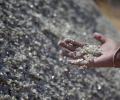
China accounts for about 70 per cent of global rare earth mining and nearly 90 per cent of rare earth magnet production, making it a dominant player and giving it significant leverage in global supply chains.

The National Pharmaceutical Pricing Authority will monitor how companies are increasing prices of non-scheduled drugs.
 © 2025 Rediff.com - Investor Information - Advertise with us - Disclaimer - Privacy Policy - Sitemap - Feedback - About us - Terms of use - Grievances